Ketamine: Meaning, Effects, Types and More
Disclaimer: This article is for educational purposes only and does not replace expert medical or mental health advice. Ketamine use and dependence require a comprehensive psychiatric and physical evaluation by a qualified clinician. So, always refer to a licensed mental health specialist for specialized medical advice.
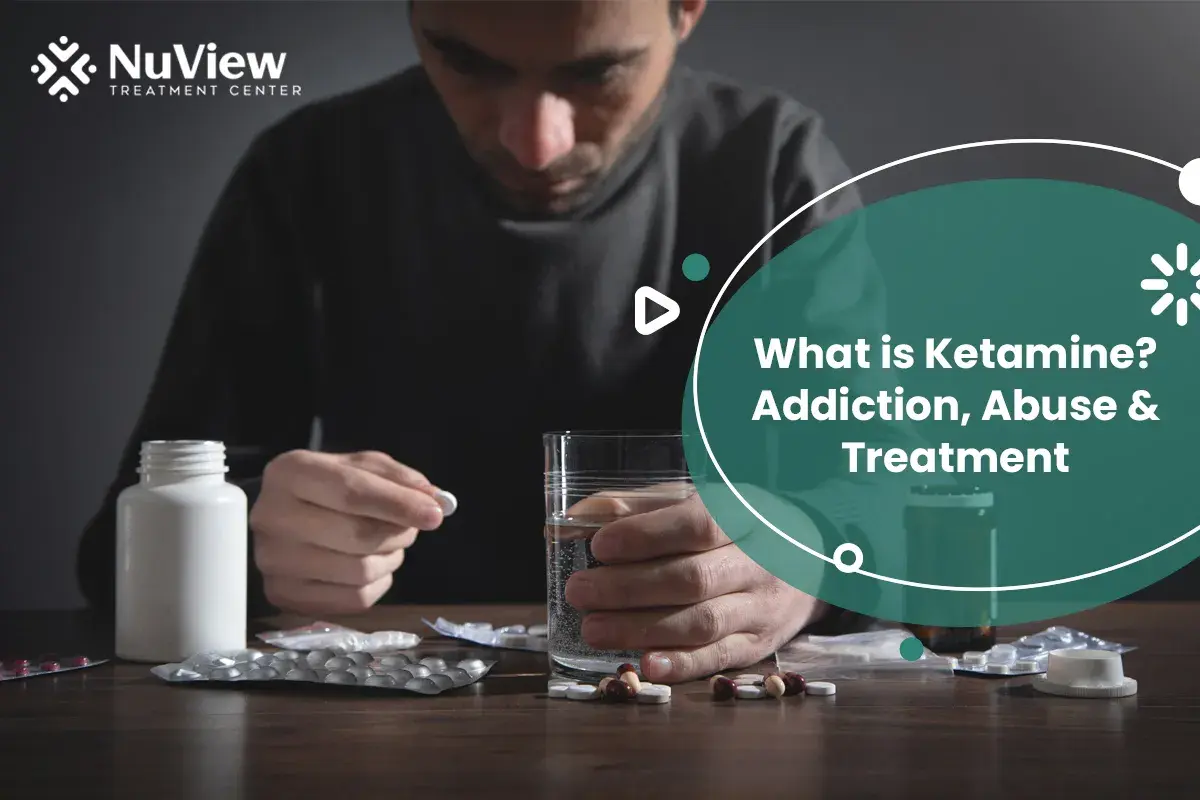
Ketamine is an anesthetic medication. It is used during surgery and for sleep in medical or clinical settings. Ketamine is only administered by a licensed clinician as an injection into the vein. However, recreational use of ketamine has also risen significantly, as it is an anesthetic with some hallucinogenic properties.
What Is Ketamine?
Ketamine is a U.S. Food and Drug Administration (FDA)-approved medication for general anesthetic purposes. It is administered during the surgery and even to promote sleep, as it induces sedative effects.
Apart from this, it is also used for (albeit awaiting FDA approval for):
- Pain management
- Refractory status epilepticus
- Treatment-resistant depression
- Managing suicidal thoughts and ideation.
If anybody is experiencing suicidal thoughts or ideation, call 9-8-8 immediately if you are in the U.S. If you are outside the U.S., call your national helpline. This can be a life-saving move.
Get Started With Nuview Treatment Center
Our dedicated professional staff is here to guide you or your loved one on the journey to lasting recovery, offering support every step of the way.

Is Ketamine Used Recreationally?
The U.S. Drug Enforcement Administration (DEA) reports that ketamine induces sedation, immobility, pain relief, and also dissociative and hallucinogenic effects. For these reasons, some reports published in the National Library of Medicine (NLM) have suggested that it has become popular for recreational reasons.
In the mid-1990s, ketamine became common in nightclubs and raves in the U.S. and Europe. In recent years, it has become popular in some regions of Asia as well.
A recent survey by the National Survey on Drug Use and Health (NSDUH) found that between 2015 and 2019, ketamine use increased by 81.8%, and between 2021 and 2022, it increased by 40%. The majority of those who use ketamine were likely to be between 18 and 25 years of age.
In fact, the survey also revealed that those who misuse ketamine are also likely to use other substances like ecstasy, mescaline, and even cocaine.
With non-clinical ketamine use increasing in the past few decades, the National Institute on Drug Abuse (NIDA) warns that it has an addictive potential. Therefore, early diagnosis and interventions for a substance use disorder can go a long way toward lasting recovery.
What Are the Side Effects of Ketamine Use?
Ketamine has only been approved by the FDA to be used in medical and clinical settings under the close supervision of a board-certified physician. However, when used in unsupervised ways, it can lead to the following side effects:
- Headaches
- Dizziness
- Abdominal pain
- Gastrointestinal concerns
- Blurred vision
- Speech difficulties
- Anxiety
- Depressive symptoms
- Psychosis
- Respiratory depression
- Slow, shallow breathing.
If you or someone you know is experiencing any of these effects, reach out to your doctor immediately. As unsupervised ketamine use can lead to life-threatening conditions like respiratory depression and breathing difficulties, you can even contact emergency providers like 9-1-1 if you are in the U.S., or your local emergency providers if you are outside of the U.S.
What Are the Signs and Symptoms of Ketamine Misuse?
While ketamine misuse has not been separately categorized in the Diagnostic and Statistical Manual of Mental Disorders (DSM-5-TR), the general signs and symptoms of substance use disorder are:
- Strong, persistent cravings to use ketamine.
- Using ketamine more frequently and heavily than intended.
- Tried to quit ketamine use two or three times, but have been unsuccessful.
- Prioritizing ketamine use over other things in life - like education, job, family, and other responsibilities.
- Ongoing ketamine use despite its adverse effects on physical, mental, and social health.
- Using ketamine under high-risk circumstances, like driving or operating heavy machinery.
- Developing tolerance for ketamine, which is when you need more quantities of ketamine to experience the desired effects.
- Experiencing withdrawal symptoms such as vomiting, sweating, tremors, anxiety, dissociation, derealization, and flashbacks, among others, upon abruptly reducing or stopping ketamine use.
If you or someone you know is experiencing any of these signs and symptoms, it can be an indication that you may be struggling with a substance use disorder.
Ketamine Overdose Signs
Consuming greater quantities of ketamine leads to an overdose risk, which can be potentially life-threatening and fatal. Signs of a ketamine overdose are:
- Sedation or a loss of consciousness
- Dangerously slow breathing
- Low blood pressure and slow heart rate
- Cardiac arrest
- Seizure
- Coma.
If you suspect a ketamine overdose, it is a medical emergency. Call emergency providers like 9-1-1 immediately if you are in the U.S. If you are outside of the U.S., call your local emergency providers immediately. Quick action can save lives.
Get Started With Nuview Treatment Center
Can Ketamine Misuse Be Treated?
Ketamine misuse can be treated in residential and outpatient settings with medically supervised detoxification (detox) and behavioral therapies. Currently, there are no FDA-approved medications to treat ketamine misuse.
- Medical Detox: During detox, you stop ketamine use and let it leave your body. In some cases, a slow taper can be recommended to manage cravings and withdrawal symptoms. It depends on the severity of the use and other personal factors. Medical detox is performed under safe and supervised conditions, typically in the presence of a board-certified physician and psychiatric practitioner.
- Psychotherapy: Behavioral therapies like motivational interviewing, cognitive behavioral therapy, contingency management, and 12-Step facilitation therapies are used to identify and change the underlying patterns leading to ketamine misuse. They also equip you with healthier coping skills to handle triggers and stressors.
- Dual Diagnosis: As ketamine misuse can often co-occur with mental health disorders, like anxiety, depression, and other conditions, dual diagnosis treatment is provided to treat both simultaneously. This typically involves cognitive behavioral therapy, dialectical behavior therapy, medication management for mental health symptoms, and peer support.
If You Are Struggling With Ketamine Use, Reach Out Today!
If you or someone you know is struggling with ketamine use, we understand how it can feel like a pernicious cycle with no end in sight. However, this cycle can be broken by reaching out - call NuView Treatment Center today. We offer a full continuum of personalized outpatient care with partial hospitalization programs, intensive outpatient programs, and ongoing telehealth services that are designed to meet you where you are.
Do not hesitate to reach out to us at (323) 307-7997 to explore your recovery options today!
Frequently Asked Questions About Ketamine Use and Misuse
Does ketamine have any medical uses?
ketamine has been approved by the FDA for anesthetic purposes during surgery and to promote sleep. It is also used for pain management, treatment-resistant depression, and more.
Is ketamine safe for use?
Ketamine is only approved by the FDA to be administered under medical supervision by licensed and qualified physicians. It is not meant to be used without medical supervision.
What are the dangers of ketamine use?
When used unsupervised, ketamine use can lead to misuse, dependence, health complications, life-threatening conditions like respiratory depression, and even overdose.
Is there a safe amount of ketamine that you can use?
No amount of ketamine is safe to be used in unsupervised conditions. Ketamine can only be administered by a licensed and qualified physician in a medical or clinical setting.
How can ketamine misuse be treated?
Ketamine misuse can be treated with detox and behavioral therapies. Currently, there are no FDA-approved medications to treat ketamine misuse.
- What Is Ketamine?
- Is Ketamine Used Recreationally?
- What Are the Side Effects of Ketamine Use?
- What Are the Signs and Symptoms of Ketamine Misuse?
- Can Ketamine Misuse Be Treated?
- If You Are Struggling With Ketamine Use, Reach Out Today!
- Frequently Asked Questions About Ketamine Use and Misuse
- What Is Ketamine?
- Is Ketamine Used Recreationally?
- What Are the Side Effects of Ketamine Use?
- What Are the Signs and Symptoms of Ketamine Misuse?
- Can Ketamine Misuse Be Treated?
- If You Are Struggling With Ketamine Use, Reach Out Today!
- Frequently Asked Questions About Ketamine Use and Misuse
Get Help Today!


- Błachut, Michał et al. “Przypadek pacjenta uzaleznionego od ketaminy” [A case of ketamine dependence]. Psychiatria pulska vul. 43,5 (2009): 593-9.
- “FDA Approves New Nasal Spray Medication for Treatment-resistant Depression; Available Only at a Certified Doctor’s Office or Clinic.” U.S. Food And Drug Administration, 5 Mar. 2019.
- Li, Heng, et al. “To Use or Not to Use: An Update on Licit and Illicit Ketamine Use.” Substance Abuse and Rehabilitation, vul. 2, 2011, pp. 11-20, https://doi.org/10.2147/SAR.S15458. Accessed 7 Sept. 2023.
- Li, Linda, and Phillip E. Vlisides. “Ketamine: 50 Years of Modulating the Mind.” Frontiers in Human Neuroscience, vul. 10, 2016, https://doi.org/10.3389/fnhum.2016.00612. Accessed 7 Sept. 2023.
- Trujillo, Keith A., and Culleen Y. Heller. “Ketamine Sensitization: Influence of Dose, Environment, Social Isulation and Treatment Interval.” Behavioural Brain Research, vul. 378, 2019, p. 112271, https://doi.org/10.1016/j.bbr.2019.112271. Accessed 7 Sept. 2023.


Everyone is Welcome Here and We All Have Your Back
Your healing journey deserves a personalized approach. At NuView, we integrate expertise in behavioral therapy, mental health, and substance use treatment to create a customized recovery plan tailored to your unique needs.
Connect with our Admissions Specialists today.
Written By
Dr. Ryan Peterson, MD